|

|
Chamber News |
|
|
|
Welcome New Members |
|
|
|
Holiday Happenings |
|
|
|
|
During this festive season, CCCBI can share the special events, sales, promotions and more things happening from our Members!
Click the button below or email abby@chescochamber.org to submit your news for an upcoming email blast! |
|
|
|
Street Closures for the West Chester Christmas Parade |
|
|
|
|
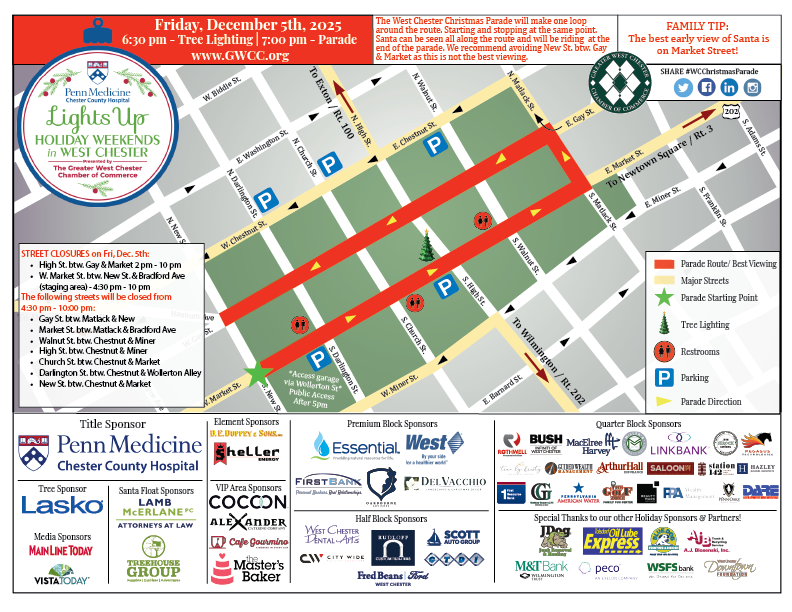
As our neighbors at the Greater West Chester Chamber of Commerce approach the date of their Annual Christmas Parade, we want to help communicate several street closures in downtown West Chester that evening.
The parade will take place on Friday, December 5th and streets will begin to shut down that afternoon at 4pm with full closure by 4:30pm.
All Streets in Parade Footprint Closed on Friday 12/5 from 4:30pm – 10:00pm.
"No parking" signs will be posted starting at 3pm that afternoon. Cars will be towed if they are parked along the parade route after 3pm. Please see this list of street closures and plan accordingly when driving or parking on the day of the parade.
|
|
|
|
Legislative Update |
|
|
|
AI and Data Centers: Opportunities & Challenges |
|
|
|
Artificial Intelligence and the development of Data Centers are changing the global economy, impacting every sector, from healthcare to manufacturing to education. Pennsylvania has stood out nationally as a highly competitive destination for AI and data center investments, with $90 billion in AI investments from companies such as Google and Amazon, resulting in a significant expansion of physical data center locations. AI and data centers do provide significant economic innovation; however, this is not without risk. AI and data center investment present opportunities, but also substantial challenges that communities and small businesses must handle with care.
Investments in AI and data centers do have economic benefits. Large-scale data centers, seen in Pennsylvania, generate significant upfront construction spending and long-term tax revenue, as well as upgrades to existing infrastructure, such as improving roads and fiber-optic networks. For example, in Loudoun County, Virginia, a new data center contributes $900 million in local tax revenue. While AI sounds solely robotic, it also requires people and provides new employment opportunities for skilled trades workers and tech workers. It's estimated that the United States will need 500,000 new electricians and other skilled workers to keep up with current demands stemming from energy consumption, and data center upstart and maintenance.
While AI and Data centers offer many economic and efficiency benefits, they also raise significant environmental concerns. AI data centers consume incredible amounts of water and electricity. Some of these data centers have used as much power as 100,000 homes. As for water usage, the required cooling water is consumed at a rate of millions of gallons a day. Data centers also affect communities, triggering the NIMBY effect due to noise from diesel generators. There is also the issue of transforming farm and forest land into open space for these data centers. As for the price for locals living near data centers, as they require an extensive use of utilities, the cost of the necessary infrastructure upgrades oftentimes will fall on ratepayers across the entire region, which increases personal electricity rates anywhere from 8%-25% percent for areas with many data centers, the people feeling the highest price are households and small businesses, already struggling with increasing utility bills.
As for small businesses, AI could become a mixed bag. AI does have an equalizing effect; it has enabled small businesses to automate some tasks, improve customer service, and manage organizational operations. Data center development also provides contracting opportunities in landscaping, engineering, hospitality, and maintenance industries, or has developers work with trade schools to create pipelines for technical careers.
However, rising electricity costs could eventually disproportionately impact small businesses that already operate on thin margins compared to large corporations. Large corporations will also offer premium wages for electricians, HVAC technicians, and maintenance workers that small businesses cannot match. Upgrading infrastructure may shut down roadways, and other disruptions are likely to occur during construction. As for environmental concerns, data centers' large space requirements may affect the look, feel, and sound of neighborhoods and cities, with economic consequences.
As for local communities, while data centers can bring revenue and upgraded infrastructure during initial economic growth from construction, they may also lead to land-use changes, air quality concerns, and strain on water and energy resources. Even with initial financial success, long-term sustainability is not a promise. Communities that rely on the initial tax revenue may encounter long–term budget shortfalls if AI companies scale back, automate, or relocate. Transparency is also becoming an increasing issue, as AI companies require non-disclosure agreements that prevent the public from accessing information on water/electricity usage and environmental impact. This leaves the public without transparency into the issues and long-term consequences that may arise if they allow data centers in their spaces.
As AI and data centers are clearly the future, whether we like it or not, there is a way to balance competing interests. Local governments may hold the power to negotiate data center agreements that align with community needs. Selecting site locations in industrialized zones with stable grid capacity and water resources that reduce the burden on communities may lead to less controversial, more sustainable development. While AI does have environmental burdens, using closed-loop cooling systems with water replenishment plans can help offset some of the environmental stressors. Transparent reporting requirements and a commitment to renewables will greatly benefit communities by enabling them to assess their own pros and cons and weigh them accordingly. For small businesses, chambers of commerce organizations can play a key role by pushing for utility protections, local procurement opportunities, targeted training programs, and AI tools and education.
AI data centers are already a promise in Pennsylvania, and engaging communities in this transition can make stakeholders feel valued and involved in shaping the future of AI and the digital economy. This moment in time is an opportunity for thoughtful integration and innovation that will provide workforce development and small-business opportunities. It is critical to have strategic planning, community engagement, and feedback to ensure the future success and sustainability of AI and the digital economy, and to ensure that small businesses have the tools to succeed. |
|
|
|
Member Spotlight |
|
|
|
Little Miss Moffitt |
|
|
|
At Little Miss Moffitt, we believe a simple, thoughtful gift can make someone feel appreciated, valued, and remembered. That belief started when Karen began baking cookies and bars for people she cared about - fueled partly by her own very serious sweet tooth, and partly by raising four in-house taste testers who kept her standards sky-high and gave very honest feedback. |
|

|
What began as a personal way to show people they mattered has grown into a business built on that same spirit of kindness and connection.
The problem we solve is simple:
We offer artisan cookies, bars, and our signature Hugs Disguised as Cookies™, created to strengthen relationships, celebrate milestones, ease tough days, and spark genuine connection. Every treat is made with high-quality ingredients, attention to detail, and a whole lot of joy. |
|

|
From single-cookie “Hugs” with custom labels to beautifully boxed assortments, every gift can be tailored with treat selections and personal notes that reflect your personality or your brand. We package it, ship it, and make you look thoughtful and organized, even on the days you’re neither.
We also proudly serve local businesses through wholesale partnerships, and since cookies and coffee are basically soulmates, we’re proud to pair with local favorites like (chamber member) Twin Valley Coffee. |
|
And our e-commerce gifting makes it easy to send both personal gifts to loved ones and professional gifts to clients and teams anywhere in the U.S.
One of our favorite compliments is: “Our clients still talk about the cookies we sent.” To us, that means the gift did exactly what it was meant to do… brighten a day, create delight, and build a lasting connection.
Little Miss Moffitt is proud to serve Chester County businesses, families, and partners across the region, with nationwide shipping that delivers your gratitude coast to coast.
Effortless gifting, heartfelt impact… delivered with care to the people who matter most to you and your business. |
|

|

|

|
Member Events |
|
|

|
We’d love to hear from and highlight your business! We are seeking member spotlight stories to include in our weekly newsletter! Email your news to abby@chescochamber.org |
|

|


